
Introduction
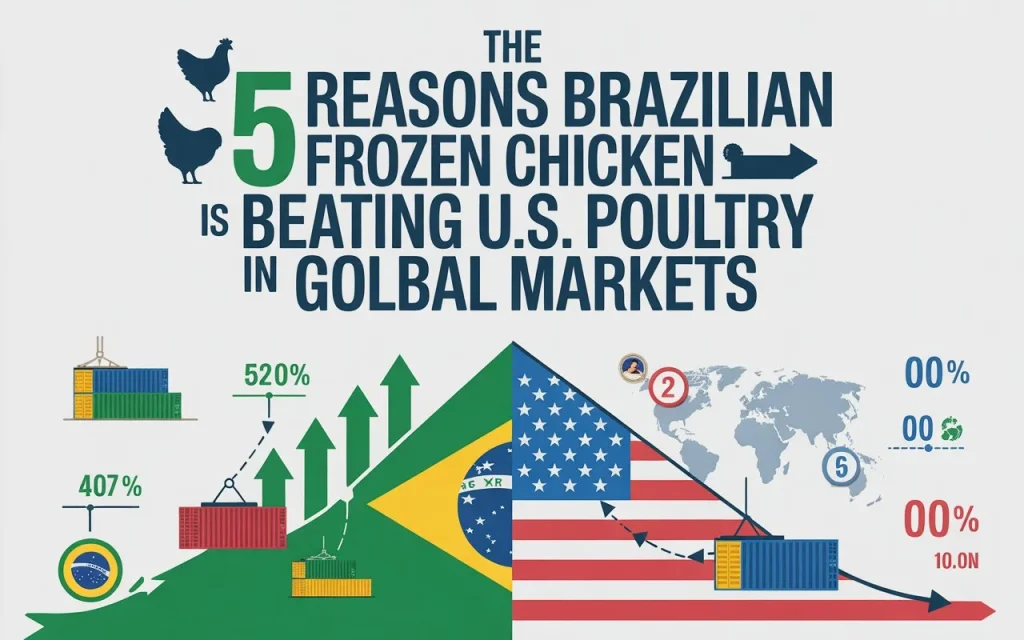
The global poultry market is dominated by two major players: Brazil and the United States. A detailed Brazil vs USA poultry export comparison helps importers, investors, and food distributors understand global supply dynamics, pricing competitiveness, halal compliance, and regional trade influence.
Both countries are among the top chicken producers worldwide, but their export strategies, market focus, and regulatory frameworks differ significantly. In 2026, Brazil continues to lead global poultry exports, while the United States remains a strong competitor with substantial production capacity.
This in-depth report analyzes production data, export volumes, key markets, pricing structures, certifications, and future outlook for both poultry powerhouses.
1. Production Volume Comparison
Brazil Chicken Production
- Annual production: Approximately 14–15 million metric tons
- Strong export orientation
- Highly integrated production systems
Brazil’s poultry production is concentrated in southern states with strong grain supply chains and export infrastructure.
USA Chicken Production
- Annual production: Approximately 20+ million metric tons
- Large domestic consumption market
- Advanced automation and industrial farming systems
The United States produces more chicken overall, but a larger percentage is consumed domestically.
2. Export Volume & Global Market Share
Brazil Export Performance
- Annual exports: Around 4.5–5 million metric tons
- Largest poultry exporter globally
- Supplies more than 150 countries
Brazil exports roughly 30–35% of its total production.
USA Export Performance
- Annual exports: Approximately 3–3.5 million metric tons
- Strong presence in Mexico, China, and Latin America
The US exports a smaller percentage of total production compared to Brazil.
3. Key Export Markets
Brazil’s Major Markets
- Middle East (Saudi Arabia, UAE, Iraq)
- Asia (China, Japan, Philippines)
- Africa (South Africa, Egypt, Angola)
- Europe (Netherlands, UK)
Brazil has strong halal-certified exports for Muslim-majority countries.
USA’s Major Markets
- Mexico (largest importer)
- China
- Cuba
- Canada
- Philippines
US exports are more concentrated in the Americas and East Asia.
4. Halal Compliance Advantage
One of the biggest differences in the Brazil vs USA poultry export comparison is halal capacity.
Brazil Halal Strength
- Largest halal poultry exporter worldwide
- Manual halal slaughter systems
- Recognized by Gulf and Islamic authorities
USA Halal Position
- Halal production available but smaller scale
- Less dominance in Middle Eastern markets
Brazil clearly dominates in halal poultry exports.
5. Pricing Competitiveness
Brazil Chicken Pricing
- Whole frozen chicken: USD 1,300 – 1,700 per MT
- Leg quarters: USD 900 – 1,200 per MT
Competitive due to feed availability and currency exchange advantages.
USA Chicken Pricing
- Often slightly higher due to labor and operational costs
- Competitive in nearby regional markets
Currency strength of the US dollar can affect pricing competitiveness.
6. Feed & Production Cost Comparison
Brazil Feed Advantage
- Large corn and soybean production
- Lower feed input costs
- Favorable climate
USA Feed Industry
- Also major grain producer
- Higher operational costs in some regions
Both countries benefit from strong feed industries, but Brazil often maintains cost advantages in export markets.
7. Trade Agreements & Market Access
Brazil Trade Strategy
- Diversified export destinations
- Strong diplomatic relations with Middle East and Asia
- Reduced reliance on single market
USA Trade Strategy
- USMCA agreement (Mexico & Canada)
- Trade tensions impact access in some markets
Brazil’s diversified export base reduces risk.
8. Sustainability & Animal Welfare
Both countries face increasing pressure regarding sustainability.
Brazil Initiatives
- Water recycling programs
- Renewable energy adoption
- Waste management systems
USA Initiatives
- Advanced automation
- Environmental compliance regulations
- Corporate sustainability reporting
Sustainability standards are tightening globally for both exporters.
9. Strengths & Weaknesses Comparison
Brazil Strengths
- Largest global exporter
- Halal market dominance
- Competitive pricing
- Diversified markets
Brazil Weaknesses
- Currency volatility
- Exposure to trade bans during disease outbreaks
USA Strengths
- Largest production volume
- Strong domestic demand
- Advanced automation
USA Weaknesses
- Higher production costs
- Limited halal export dominance
10. Future Outlook (2026–2030)
Global poultry demand is expected to grow steadily due to:
- Population growth
- Urbanization
- Rising protein consumption
Brazil is likely to maintain export leadership, especially in halal markets, while the USA remains strong in regional trade and domestic consumption.
Frequently Asked Questions (FAQs)
1. Who exports more chicken, Brazil or USA?
Brazil exports more poultry globally, although the USA produces more overall.
2. Why is Brazil the largest poultry exporter?
Strong halal compliance, competitive pricing, diversified markets, and export-focused production.
3. Is US chicken cheaper than Brazilian chicken?
Pricing varies by region, but Brazil often maintains export price competitiveness.
4. Which country dominates halal poultry exports?
Brazil is the global leader in halal chicken exports.
5. Which country produces more chicken overall?
The United States produces more total chicken annually.
6. Which country has more export diversification?
Brazil exports to over 150 countries, offering strong diversification.
7. What affects poultry export pricing?
Feed costs, currency exchange rates, labor costs, and shipping rates.
8. Who will lead poultry exports in the future?
Brazil is expected to maintain leadership, with the USA remaining a strong competitor.
Conclusion
The Brazil vs USA poultry export comparison highlights two global poultry giants with different strengths. While the United States leads in total production volume, Brazil dominates global export markets—particularly in halal-certified poultry and diversified international trade.
For importers and investors, understanding these differences helps in selecting reliable suppliers, managing price expectations, and identifying long-term trade opportunities.