
Introduction
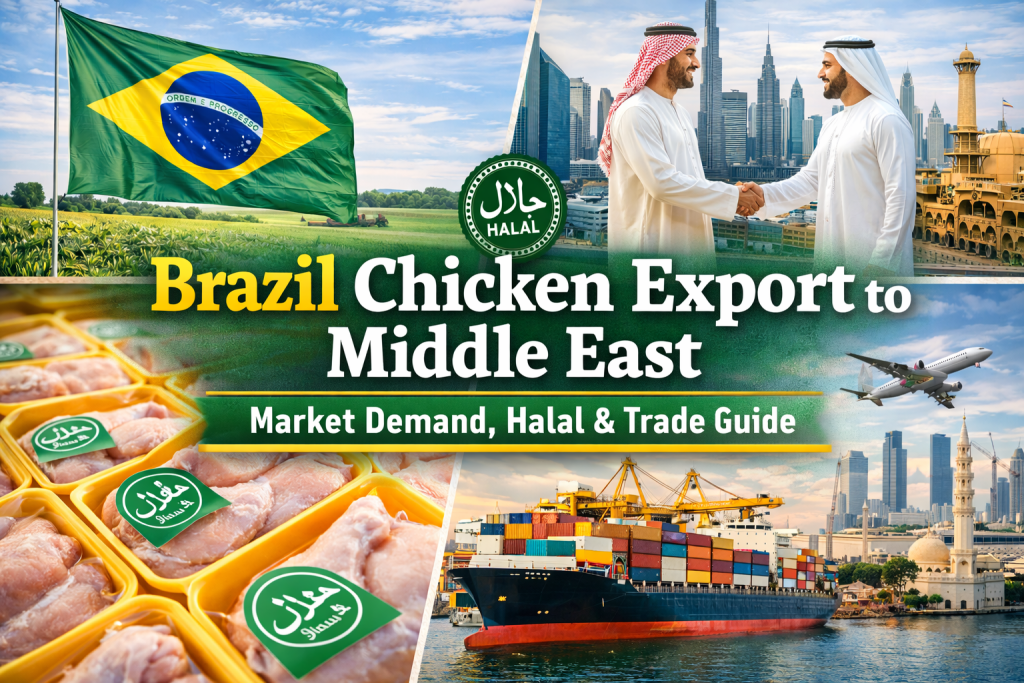
Brazil is the largest exporter of chicken meat in the world, and the Middle East is one of its most important and stable markets. Countries like Saudi Arabia, UAE, Iraq, Kuwait, Oman, and Qatar rely heavily on Brazilian poultry due to strict halal compliance, competitive pricing, consistent supply, and strong logistics infrastructure.
For importers, wholesalers, food distributors, and government buyers, Brazilian chicken offers a reliable solution for meeting rising protein demand across the Gulf and wider Middle East.
This guide explains how Brazil exports chicken to the Middle East, covering halal standards, major importing countries, product types, certifications, prices, and the full export process.
Why the Middle East Depends on Brazilian Chicken
The Middle East is one of the world’s fastest-growing poultry import regions due to:
- Limited domestic poultry production
- Rapid population growth
- High consumption of chicken meat
- Strong preference for halal-certified products
Brazil meets all these needs efficiently.
Key Advantages of Brazilian Poultry
- 100% halal slaughter compliance
- Competitive export pricing
- Large-scale production capacity
- Advanced cold-chain logistics
- Strong government and industry oversight
Brazilian exporters work closely with Islamic authorities to ensure religious compliance, making Brazil a trusted long-term partner for Middle Eastern nations.
Top Middle East Countries Importing Chicken from Brazil
Saudi Arabia
Saudi Arabia is the largest importer of Brazilian chicken. Most imports are frozen whole chicken and chicken cuts supplied to:
- Retail chains
- Food service companies
- Government food programs
Brazilian poultry plants exporting to Saudi Arabia must be approved by the Saudi Food and Drug Authority (SFDA).
United Arab Emirates (UAE)
The UAE acts as both a consumer market and a re-export hub. Brazilian chicken is widely used in:
- Hotels and restaurants
- Catering companies
- Free zone trading
Iraq
Iraq is a high-volume market importing frozen whole chicken and leg quarters due to affordability and supply consistency.
Kuwait, Oman & Qatar
These Gulf countries import premium halal chicken cuts, boneless products, and value-added poultry items from Brazil.
Halal Compliance: The Foundation of Brazil–Middle East Trade
Halal compliance is the most critical factor in exporting chicken to the Middle East.
How Brazil Ensures Halal Integrity
- Muslim halal supervisors present during slaughter
- Manual hand slaughter (Zabiha)
- Islamic prayers recited per bird
- Segregated halal production lines
- Halal-certified cold storage and transport
Brazil works with internationally recognized halal bodies accepted by Middle Eastern governments.
🔗 External Reference: Brazilian Animal Protein Association (ABPA)
Popular Brazilian Chicken Products Exported to Middle East
Brazil exports a wide range of poultry products tailored to Middle Eastern market preferences.
Whole Frozen Chicken
- Weight range: 900g – 1200g
- Individually packed
- High demand in Saudi Arabia and Iraq
Chicken Cuts
- Leg quarters
- Drumsticks
- Wings
- Breast fillet
Boneless & Processed Poultry
- Boneless breast
- Skinless cuts
- Marinated and value-added products
🔗 Internal Link: Brazil Frozen Chicken Exports
Brazil Chicken Export Prices to Middle East
Prices vary depending on:
- Product type
- Order volume
- Packaging
- Destination port
- Seasonal demand
Average Export Price Ranges (Indicative)
- Whole frozen chicken: USD 1,300 – 1,700 per MT
- Chicken leg quarters: USD 900 – 1,200 per MT
- Chicken breast: USD 2,200 – 2,800 per MT
Prices are typically quoted FOB Brazil or CIF Middle East ports.
Required Certifications & Documents
To export chicken from Brazil to the Middle East, exporters must provide:
- Halal certificate
- Veterinary health certificate
- Certificate of origin
- Commercial invoice
- Packing list
- Bill of lading
Each importing country may have additional documentation requirements.
Export Process: Step-by-Step
- Buyer sends product specifications
- Exporter provides quotation
- Halal and regulatory approval confirmed
- Production and quality inspection
- Cold storage and container loading
- Shipment via sea freight
- Customs clearance at destination
Logistics & Shipping Routes
Brazil exports poultry to the Middle East mainly through:
- Port of Santos
- Port of Paranaguá
- Port of Itajaí
Transit time ranges from 25 to 40 days, depending on destination.
Challenges & Risk Management
Despite strong demand, exporters and importers should manage:
- Currency fluctuations
- Changing halal authority rules
- Import license delays
- Cold chain monitoring
Working with experienced Brazilian exporters reduces these risks significantly.
Future Outlook for Brazil Chicken Exports to Middle East
The demand for Brazilian chicken in the Middle East is expected to grow steadily due to:
- Rising population
- Food security initiatives
- Expansion of food service sector
Brazil remains well-positioned to meet future demand with sustainable and scalable poultry production.
Conclusion
Brazil chicken exports to the Middle East represent a strong, stable, and halal-compliant trade partnership. With world-class production standards, competitive pricing, and deep understanding of Islamic requirements, Brazil continues to dominate poultry imports across the region.
For importers seeking reliable halal chicken suppliers, Brazil remains the top global choice.